
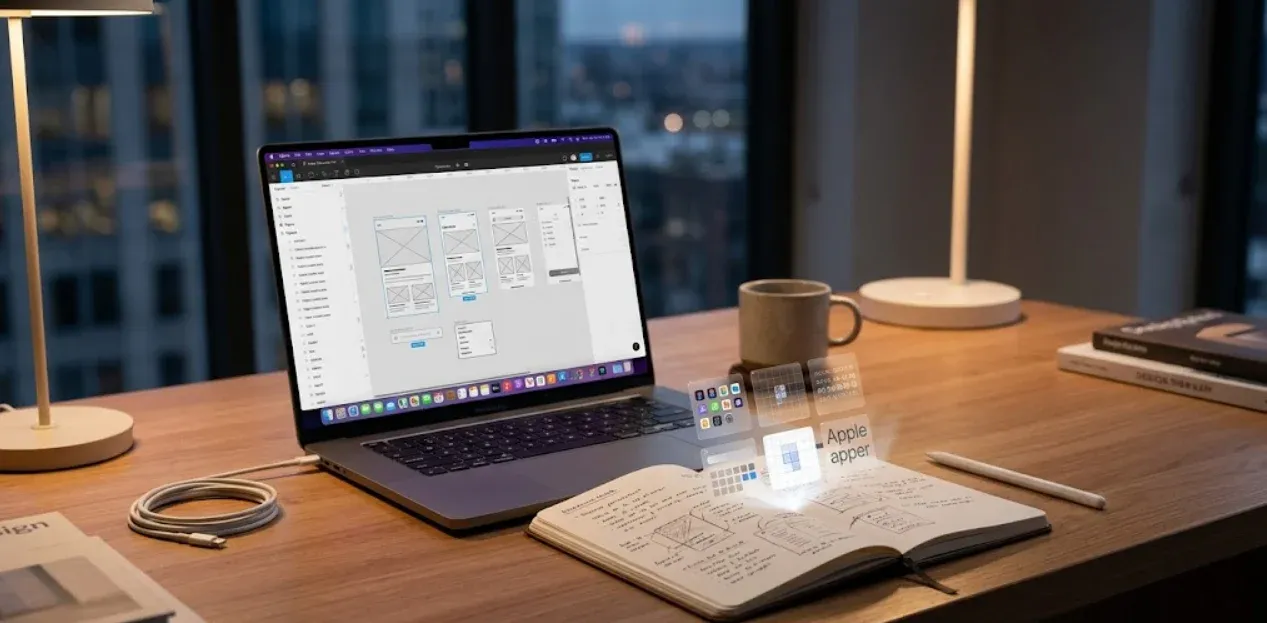
Bridging the Gap Between Analog Sketches and Digital Products
Every digital layout starts as a mess of analog lines. Last night, I was mapping out an interface flow and realized how much my graphic design background dictates my product UI—even down to how I sketch grids by hand before touching Figma.
Here is how to translate raw notebook scribbles into structured, scalable screen layouts without losing the initial creative spark in the process.
The Power of the Physical Grid
When you sit in front of a blank Figma canvas, the infinite digital space can actually paralyze your decision-making. Starting in a physical notebook forces constraints.
- Tactile Restrictions: A standard notebook page forces you to think about spatial relationships and micro-hierarchy before you get distracted by hex codes or pixel alignments.
- Speed Over Perfection: Your brain moves faster than your trackpad. Sketching allows you to burn through five bad layout ideas in two minutes.
The goal of an analog sketch isn’t to draw perfect UI elements; it’s to map the logical relationships between components.
Translating Kinetic Energy to Digital Structure
The biggest trap designers fall into is trying to literally copy their sketch onto the screen. Instead, look for the underlying geometry of your scribbles.
- Identify the Hero: Look at your sketch. Where did your pen naturally create the most visual weight? That is your primary structural container.
- Apply Graphic Principles to Product UI: This is where graphic design meets product design. Use classic print layout rules—like asymmetric balance and intentional negative space—to bring life to standard digital containers.
The Figma Transition
Once the skeleton is proven on paper, move to the screen with a strict ruleset. Turn your hand-drawn lines into a rigid layout grid (whether it’s an 8pt system or a fluid columns system).
Keep the soul of the sketch alive by maintaining those unexpected spacing choices or bold typographic pairings you stumbled into while drawing away from the screen.
What does your ideation phase look like? Do you go straight to digital, or are you still hoarding notebooks like me?